What tribology measures
Tribology is the science of friction, wear and lubrication between surfaces in relative motion. A tribometer loads two test specimens together and records friction torque and temperature as the load rises.
Ceramizator products are tested in independent laboratories and on real vehicles. Below is what was measured, where, and what it means in practical terms.
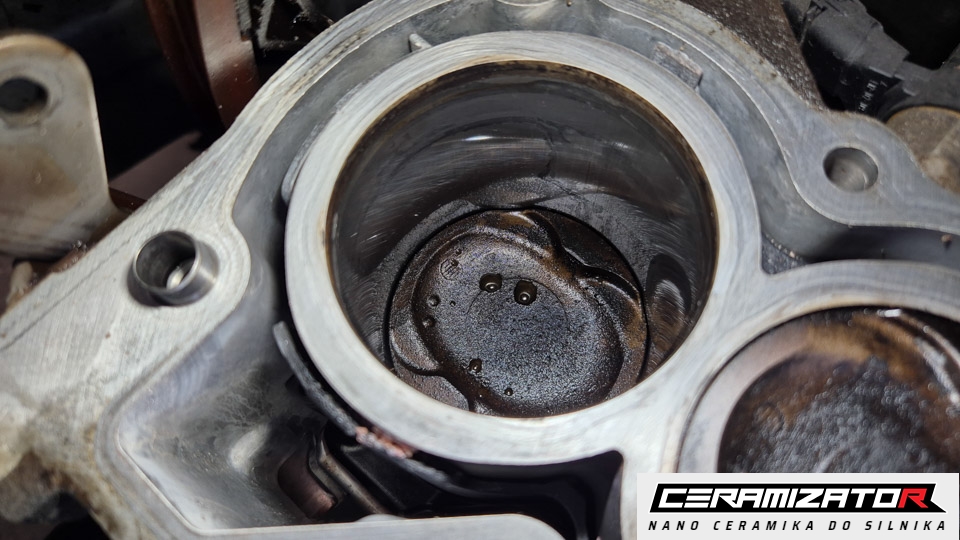
Compression was measured on a ten-year-old vehicle with approximately 150,000 km on the odometer, before and after treatment. Cylinder pressure is a direct read on how well the piston, rings and cylinder wall still seal.
7.87 bar rising to 8.05 bar. The mechanism is straightforward: the ceramic layer removes scoring, scratches and high spots from cylinders, pistons and rings — the defects that let pressure escape and cost power.
Sound level was recorded at the same point on the same engine, before and after treatment, with a hand-held sound level meter. Quieter running is the audible side of the same effect that shows up as lower friction torque in the laboratory.
A reduction of roughly 5.7 dB. Because the decibel scale is logarithmic, that is a substantial drop in measured sound energy, not a marginal one.
Anti-seize and anti-wear properties were assessed at the Automotive Industry Institute (Przemysłowy Instytut Motoryzacji, PIMOT) in Warsaw, Poland — a state research institute specialising in automotive testing.
Tribology is the science of friction, wear and lubrication between surfaces in relative motion. A tribometer loads two test specimens together and records friction torque and temperature as the load rises.
The same base lubricant was run with and without the additive under an identical initial load of 1,962 N, so the only variable in the comparison was the presence of the ceramic revitalizer.
Lower friction torque and lower contact temperature under the same load mean less energy wasted as heat and a wider safety margin before seizure — the conditions that destroy engines.
Both samples were run on the same tribometer at the same initial load. The blue trace is friction torque, the red line is temperature, and the black line is the applied load. Lower and flatter is better.
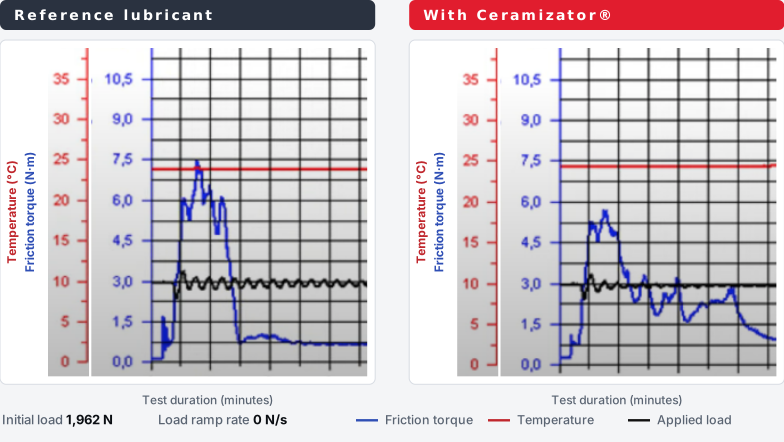
The reference sample spikes hard as the load comes on, then collapses to a low plateau once the surfaces have worn into each other — the signature of material being removed.
The treated sample peaks lower and settles into a steadier band, with the ceramic layer carrying the load instead of the bare metal underneath it.
Plotted data is taken directly from the laboratory record; axis titles, headings and the key have been translated into English. Vertical scales are cropped above 11 N·m, where neither trace goes.
The figures on this page come from manufacturer testing and from laboratory work commissioned in Poland. They describe specific engines under specific conditions, not a guaranteed outcome for every vehicle. An engine with heavy mechanical damage, a failed ring pack or a burnt valve will not be repaired by an oil additive. What the technology addresses is surface wear — and that is what was measured.
The technology page walks through the tribochemical mechanism, the honing question, and the chemistry of the layer itself.